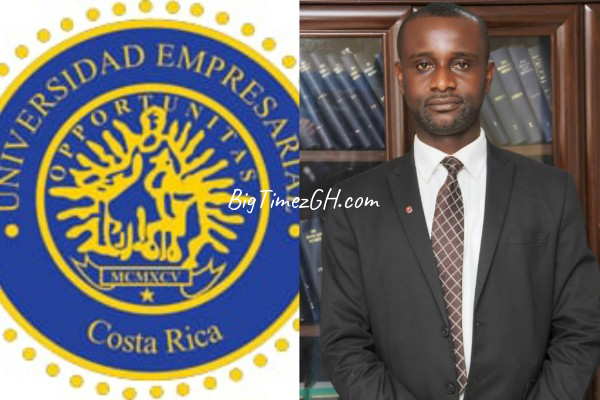
The Adentan High Court in Accra has delivered a major ruling in favour of holders of doctoral degrees from the Universidad Empresarial de Costa Rica (UNEM), setting aside a Ghana Tertiary Education Commission (GTEC) directive that sought to bar the use of UNEM qualifications in the country’s tertiary education sector.
GTEC’s directive, issued on 5 November 2025 and addressed to all public tertiary institutions, instructed universities and colleges not to recognise UNEM degrees for teaching, appointment, promotion, or related academic purposes. The order triggered widespread concern among affected academics and professionals across the country.
In his ruling, Justice Kwame Gyamfi of the Adentan High Court delivered what legal observers have described as one of the most significant judicial pronouncements in recent years on administrative fairness, higher education regulation, and the protection of vested rights in Ghana.
The case was brought by a group comprising mainly university academics and professionals whose qualifications and career progression had been harmed by GTEC’s directive. They challenged the legality of the directive and the procedure through which it was issued.
Represented by counsel Solomon Faakye, Esq., the applicants argued that GTEC acted unlawfully by retrospectively invalidating qualifications that had already been recognised and relied upon for appointments, promotions, teaching, and other academic purposes. They further contended that the commission failed to follow mandatory legal procedures governing the suspension or revocation of accreditation under the relevant regulatory framework.
The applicants also maintained that GTEC’s actions violated the principles of natural justice, legitimate expectation, fairness, and administrative legality. Counsel argued that public institutions and universities could not lawfully take punitive measures against holders of the affected qualifications based on an unlawful directive.
Upholding these submissions, the court held that statutory bodies such as GTEC are bound by law and must act strictly within the limits of their granted powers. It found that the impugned directive and the process leading to it were legally flawed and could not justify the adverse consequences imposed on degree holders.
Justice Gyamfi granted several reliefs in favour of the applicants, including declarations that the directive was unlawful, invalid, and of no legal effect. The court expressly held that all qualifications obtained before the GTEC directive was issued remain valid and cannot lawfully be invalidated retrospectively.
The court further quashed the directive and restrained GTEC from acting on or enforcing it against affected persons. Additionally, it ordered all tertiary institutions that had implemented the directive or taken adverse decisions against holders of UNEM qualifications to reverse such actions.
It will be recalled that in recent months, GTEC has intensified a nationwide crackdown on what it describes as fake, unaccredited, or improperly used academic qualifications and honorary titles. That campaign has included directives against unaccredited institutions, the abuse of honorary doctorates, and the use of questionable foreign qualifications. The UNEM directive was part of that broader regulatory drive.
The judgment is expected to have far-reaching implications for universities, public institutions, and regulatory bodies in Ghana’s higher education sector, particularly those that had implemented or relied on GTEC’s directive in matters of appointments, promotions, confirmations, and academic recognition.
Source By DC Kwame Kwakye