
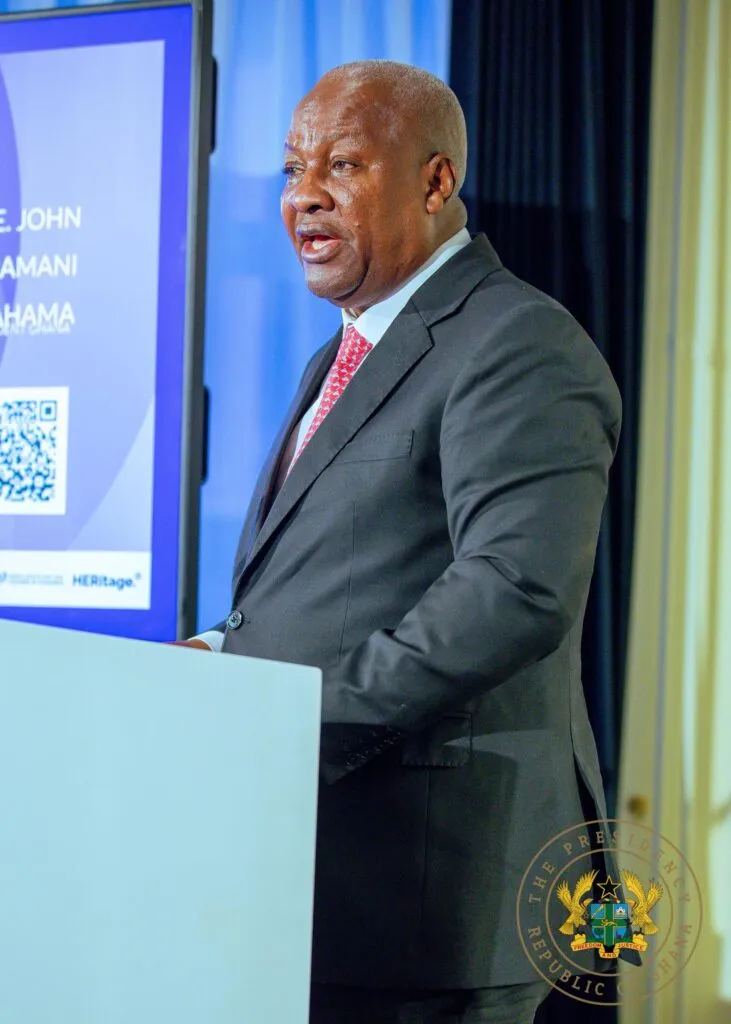
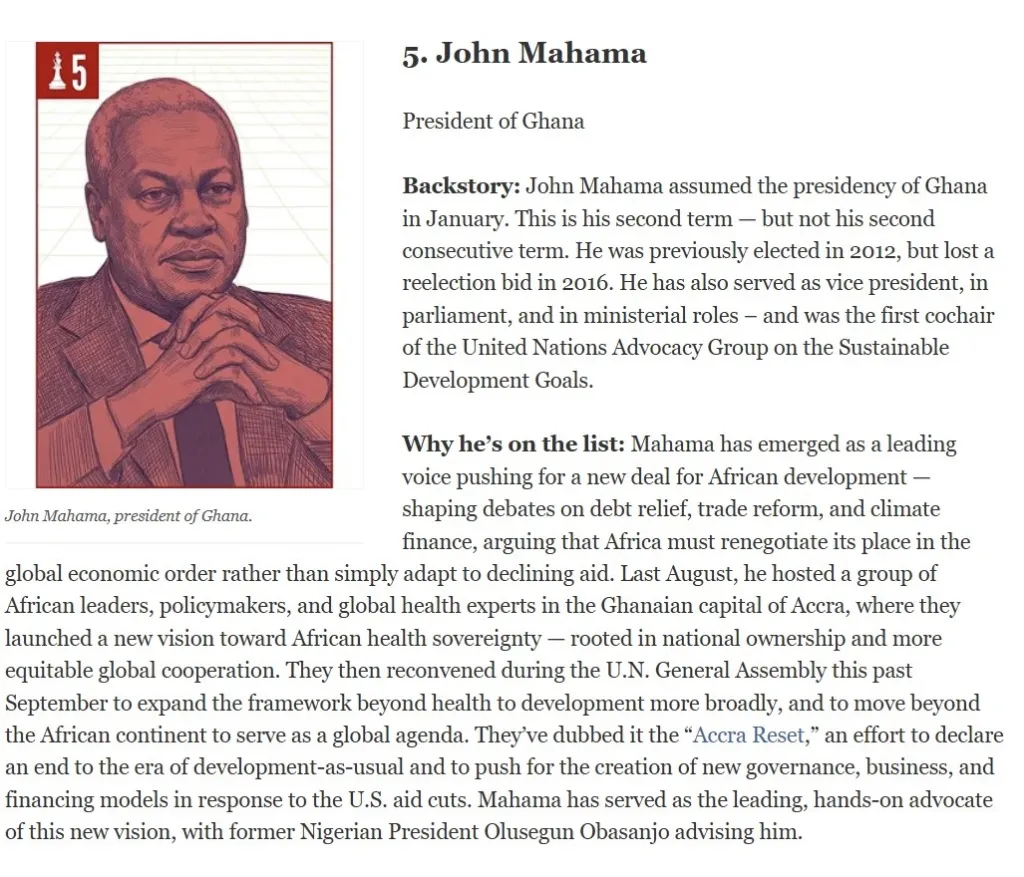
President John Dramani Mahama has been ranked 5th on the 2026 Devex Power 50 list, placing him among the world’s most influential figures shaping the future of global development at a time when traditional aid systems are undergoing profound transformation.
The annual Devex Power 50 is a highly regarded global ranking that identifies individuals wielding exceptional influence over development policy, financing, and innovation. The 2026 list comes amid what Devex describes as a “post-aid era,” marked by declining foreign assistance from traditional donors, especially the United States and parts of Europe, and the rapid emergence of new actors such as philanthropy, development finance institutions, private capital, and middle-income country donors.
President Mahama’s inclusion in the top five underscores his growing stature not only as Ghana’s leader but also as a major political voice redefining Africa’s role in the global development architecture.
Power beyond money
According to Devex, power in global development today is no longer measured solely by financial contributions. Instead, it is increasingly defined by the ability to shape narratives, influence policy direction, mobilise coalitions, and reimagine how development is financed and delivered.
“Power is about influence – who sets the agenda, who reframes the debate, and who can mobilise action across borders,” Devex noted in its 2026 assessment.
It is within this context that President Mahama’s ranking is seen as particularly significant. Having assumed office in January for a non-consecutive second term, Mahama has positioned himself as one of Africa’s strongest advocates for systemic reform rather than short-term aid dependence.
Why Mahama Ranked 5th
Devex attributes Mahama’s high ranking to his consistent and forceful advocacy for what he describes as a “new deal” for African development. Central to this vision are calls for comprehensive debt relief for African countries, fairer global trade rules, and climate financing frameworks that reflect Africa’s realities rather than donor-driven priorities.
Rather than urging African governments to simply adjust to shrinking aid flows, Mahama has argued that the continent must fundamentally renegotiate its place in the global economic system.
“Africa must move away from dependency toward sovereignty, ownership, and sustainable financing models,” Devex paraphrased Mahama’s position.
This approach has resonated strongly at a time when many African economies are grappling with high debt burdens, climate shocks, and reduced fiscal space following the COVID-19 pandemic and global economic disruptions.
The Accra Reset Initiative
One of the major initiatives cited by Devex is Mahama’s leadership in launching what has become known as the “Accra Reset” a bold framework aimed at ending what critics describe as “development-as-usual.”
In August last year, Mahama convened African leaders, policymakers, global health experts, and development partners in Accra to advance a new vision for African health sovereignty, rooted in national leadership, regional manufacturing capacity, and more equitable global cooperation.
The initiative gained further international attention at the United Nations General Assembly in September, where discussions expanded beyond health to encompass development financing, governance reform, and Africa’s strategic positioning in a world of declining U.S. foreign aid.
The Accra Reset calls for new governance, business, and financing models that reduce Africa’s vulnerability to external shocks while strengthening domestic capacity and regional integration.
President Mahama serves as the initiative’s chief political advocate and works closely with former Nigerian President Olusegun Obasanjo, who plays an advisory role in shaping the process.
A Global Voice Beyond Ghana
Devex noted that the most powerful actors in global development today are often not the most visible. Influence increasingly operates behind the scenes, across governments, multilateral institutions, philanthropy, global health, climate policy, and emerging technologies such as artificial intelligence.
Mahama’s 5th place ranking reflects his ability to operate effectively across these spaces, bridging political leadership with global policy debates.
While Ghana remains his primary responsibility, Devex observed that Mahama’s influence now extends far beyond national borders, positioning him as a key agenda-setter in global discussions on development reform in 2026 and beyond.
Africa’s Moment in a Shifting World
The 2026 Power 50 list emerges at a time when global development is being reshaped by multiple forces: donor fatigue, geopolitical tensions, climate emergencies, and growing skepticism about traditional aid effectiveness.
Against this backdrop, Mahama’s rise in global influence signals what many analysts see as a broader shift – Africa increasingly speaking for itself rather than being spoken for.
For Ghana, the ranking enhances the country’s diplomatic profile and reinforces Mahama’s long-standing reputation as one of Africa’s most globally engaged leaders.
For the continent, it highlights the growing recognition of African leadership in defining the future of development, rather than merely responding to decisions made elsewhere.
Looking Ahead
As debates over development financing, climate justice, debt restructuring, and global equity intensify, Devex’s recognition of President Mahama suggests that his ideas and leadership will continue to shape conversations well beyond 2026.
In a rapidly changing world order, the ranking places Ghana’s president firmly among the individuals to watch – not just as a national leader, but as a global development influencer helping chart a new course for Africa and the wider Global South.
Source By Prince Kwame Wonder


Comments are closed.